Tuesday, June 19, 2018

Ethereum Mining, GPU Mining Rig Is Still Strong

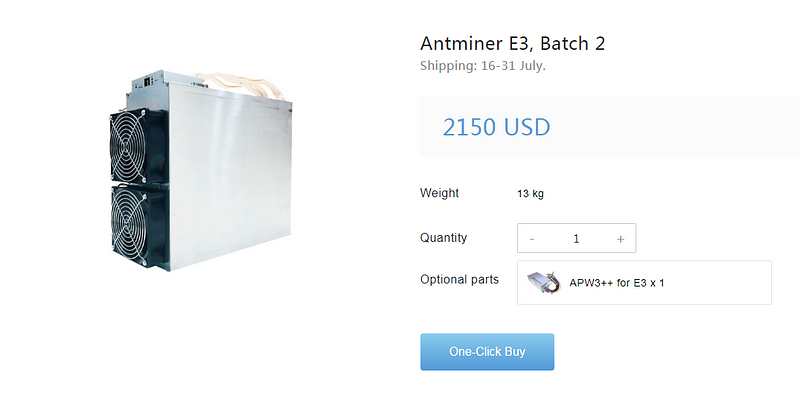
Bitmain released the brand new Antminer E3 in overseas markets — an upgrade of Ethereum miner which is very likely to lead to losses for existing miners. The price of E3 has risen fast since it’s released. The so-called ASIC Ethereum miner failed the high expectation in terms of higher hashrate and less power consumption, and it’s performance is way worse than ASIC miners.
Why doesn’t E3 have obvious advantages? Let’s make a comparison between E3 and PandaMiner B3 Pro, which is currently the most powerful GPU integrated miner in the market. Of course you can put your own graphics card machine in the comparison too:

Cost

As Antminer E3 is an ASIC miner, it is impossible for it to weigh of 13KG. And it is very likely that it’s installed with 6 chips built-in graphics cards. It is worth noting that Antminer E3 for this batch only supports overseas shipping. According to the logistics partner UPS, the minimum shipments cost for one unit is around $150. Plus an official power supply of $105 yuan, the total unit cost will reach as high as $2405, or $13 for each MHS.
While PandaMiner B3 Pro is integrated with AMD RX470 4G graphics cards, and the market price of 8 graphics cards is around $2158. Added with power supply, motherboard, chassis and other parts, the total costs is quite transparent.
ModelRetail PricePower SupplyShipping CostTotal CostHashrateMhs CostAntminer E3$2150$105$150$2405180MHS$13.36/MHSPandaMiner B3 Pro$2508$0$0$2508220MHS$11.4/MHS
By contrast, costs to get an E3 are even higher due to limited supply, and it’s not hard to imagine that miners will choose the most competitive product. Not only the cost of purchase, delivery time is also another important aspect.

Delivery

The delivery for B3 only takes 7 working days. However, it is expected to make delivery in July for E3, meaning still 3 months to go. With such a long waiting period, B3 totally will win over E3 in profits. Check the current profit ratio as follows:
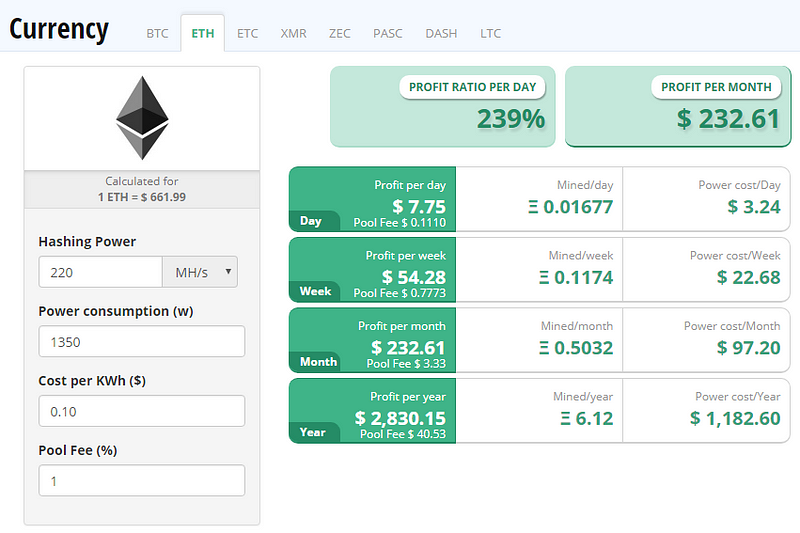
And what will happen in three months is clear to everyone — 3 months loss of time and efficiency. Miners don’t want to waste their time which equals to mining profits.

Specifications

Antminer E3 runs 180 MHS hashpower for ETH mining, similar to all miners running 6 graphic cards. PandaMiner B3 Pro runs 220 MHS on the other hand, and the power consumption is basically 1300W. The difference in power consumption is not significant with the same hashrate, so E3 does not have a win either in power consumption.

Scrap Value

Now let’s compare the residual value of both miners. PandaMiner B3 Pro is a GPU integrated miner with a normal display output. The price of second-hand graphics cards in the market is still considerable. While an E3 can maintain after being obsolete as it is ASIC miners designed only for mining.
In summary, GPU mining is still strong and more adaptable to the market, and the price of Antminer E3 is not at all competitive for mining. The majority of miners can continue to stick to GPU mining. Compared with ASIC miners pegged to certain coins, GPU mining is more feasible and can stand the test of the market in the long run. Another major threat to E3 is that Ethereum is able to resist the ASIC miner through hard fork, if ti’s supported by the Ethereum community.

Altcoins mining

GPU miners support a lot of altcoins, as follows. Generally speaking, GPU miner is more flexible and can quickly switch coin types according to profitability. The current higher-yielding coins are ETH, XMR, ZEC and so on, and miners can choose their coin types based on their preference. After all, the cryptocurrency development changes too fast. Perhaps one of the following will become a potential black horse.
AlgorithmsCoinEthashETH//ETC/ELLA/ETP/ETFGroestlGRSX11GostSIBCryptoNightXMR/ETN/XDNEquihashZEC/BTG/BPALyra2REv2XVG/MONANeoScryptFTC/VIVOBlake(14r)DCRPascalPASLNIST5BWKXevanBSDX14HSRX13sm3BCD
About PandaMiner:
PandaMiner is a professional cryptocurrency hardware R&D technology company. With strong technology and R&D strength, PandaMiner stands out in the field of graphics card mining, and successfully produces stable integrated graphic card miners with high performance and low power consumption. PandaMiner has units that make miner R&D, cloud mining, miner hosting, mining pool, almost covers the entire cryptocurrency mining industry chain. Our vision is to perfect our products to meet the demands of the ever-growing mining industry and make mining simple.
For more details, please click official website: https://pandaminer.com/.

Tuesday, January 9, 2018

5G Network Brings New Opportunity to Optical Communication

At present, 5G is in the crucial stage of the formation of technical standards. Major countries and operators in the world have started the 5G test in succession and successively issued strategic plans to carry out industrial layout and seize strategic high ground. China is also actively promoting the 5G technology research and industrialization, 5G technology research and development testing, international standardization support continue to make new progress. Recently, more than three major operators 5G infrastructure, total spending within seven years will reach 180 billion U.S. dollars heavy news came out, the 5G topic to an unprecedented peak.


As we all know, the future of 5G depends on small base stations. When the coverage of base stations is getting smaller and smaller, the number of base stations will increase exponentially. Taking the example of 3.5GHz, the number of base stations of 3.5GHz is more than the number of base stations of 800MHz and 1.8GHz Doubles. If it is planned more than 6GHz, the number of base stations will be more. If it is planned to 26GHz above, it does not know it will reach how many times. Therefore, a substantial increase in the number of base stations is an inevitable result, and the interconnection between base stations requires a lot of fiber. It is reported that at present, the number of base stations in China has reached more than 5 million, while the future development of 5G, conservative forecasts will reach 10 million or more, if the high-band, or even more.

Obviously, optical communication and 5G have met by chance. Accordingly, what is the impact of 5G on optical communications? The opportunities that 5G brings to optical communication are mainly including three parts: optical fibers, optical transceivers and optical network.

1. First, optical fiber is the first beneficiary. 5G band is high and the number of base stations may be 2-3 times. If following the full coverage requirements, according to Fiber Broadband Association estimates, 5G fiber usage will be 16 times more than 4G. Consider China's 4G base station density is very high, the urban area only a few hundred meters spacing, it is estimated that the amount of 5G fiber is 4G 2-3 times.

2. Second, optical transceiver module is the second beneficiary. Assuming that the 5G base station is 2-3 times as much as 4G, considering the medium / backhaul module, it is expected to bring tens of millions of 25GHz high-speed optical module usage. 5G flat architecture to the traditional huge capacity and cost pressures, which requires a large number of optical transceivers to support.

3. Moreover, high-speed optical access network systems and optical devices are the third beneficiaries. The 5G architecture enables several decades of backhaul / midamble / preamble capacity up to tens of hundreds of Gbps levels and requires the introduction of 25G / 50G based CWDM or WDM for tunable lasers, tunable filters and CWDM / WDM devices High cost performance requirements; for TWDM PON systems, the demand for eCPRI and even edge ROADM systems is likely to increase significantly.

To sum up, we are currently at the pinnacle of opportunities and challenges in the 5G era. As the leading optical communications industry and optical component manufacturer in the 5G era, Gigalight has been closely following the market and moving ahead of 2016 in preparation for the beginning of 5G optical device product lines. At present, Gigalight owns a complete line of professional optical modules and other products. In particular, a large number of high-speed new products are launched in last year: 100G QSFP28 CWDM4, 100G QSFP28 PSM4, and 200G QSFP DD SR8.


Wednesday, December 20, 2017

Differences between QSFP28 PSM4, QSFP28 SR4 and QSFP28 LR4

The appearance of the QSFP28 optical transceiver is the same as that of the 40G QSFP + optical transceiver. The difference is that QSFP28 optical transceiver can transmit optical signals up to 100G. Therefore, QSFP28 optical transceiver has become the mainstream 100G optical transceiver and the preferred solution for network upgrade of 100G. This article describes the differences between the QSFP28 PSM4 optical transceiver, the QSFP28 SR4 optical transceiver, and the QSFP28 LR4 optical transceiver.

The Definition of Different Types of QSFP28 Optical Transceiver:

QSFP28 PSM4 optical transceiver is a high-speed, low-power product with a hot-swappable QSFP form factor with built-in digital diagnostics and eight optical fibers, each with a data rate of 25Gbps.

QSFP28 SR4 optical transceiver is a parallel 100G optical transceiver with the advantages of high port density and low cost. If you need a short distance transmission of optical transceivers for 100G network upgrade, you can choose QSFP28 SR4 optical transceiver.

QSFP28 LR4 optical transceiver, an optical transceiver with transmission distances up to 2km, provide an ideal solution for the ever-increasing transmission distance requirements of very large data centers and will lead the use of single-mode optical fibers in the data center.

QSFP28 Optical transceiver Differences:

1. Transmission Methods

As we all know, QSFP28 optical transceiver usually has four transmission channels, and each channel data rate is 25Gbp. This transmission is very similar with 40G QSFP + optical transceiver transmission. 100G QSFP28 SR4 and 100G QSFP28 PSM4 optical transceivers are 12-way MTP interface, while the realization of the 8-way fiber 100G transmission is bidirectional. But the 100G QSFP28 LR4 optical transceivers cannot do this, QSFP28 LR4 optical transceiver is transmitted at the same time in two uses of LC duplex fiber in one direction for 100G transmission.

2. Transmission Media and Transmission Distance

QSFP28 PSM4 optical transceiver, QSFP28 SR4 optical transceiver and QSFP28 LR4 optical transceiver transmission distance are also different. QSFP28 SR4 optical transceiver operates at 850nm and is used with OM3 or OM4 multimode fibers for transmission distances of up to 70m with OM3 fibers and up to 100m with OM4 fibers. QSFP28 LR4 optical transceiver is usually used with single-mode fiber, which operates at 1310 nm and has a maximum transmission distance of up to 2km. QSFP28 PSM4 optical transceiver, is generally used with a 12-way MTP interface and single-mode optical fiber with a transmission distance of up to 500m.

3. The Wiring Structure Is Different

Optical transceiver transmission in the optical fiber routing has a very important role. Because the QSFP28 SR4 optical transceiver and the QSFP28 LR4 optical transceiver are used for short-distance transmission and long-distance transmission respectively, their wiring structures are different. The former requires multi-fiber cabling based on a 12-way MMF MTP interface, while the latter requires only a traditional two-fiber SMF cabling. In this case, the conversion between multimode fiber and single-mode fiber is very complicated because they use a completely different wiring structure.

Although QSFP28 PSM4 optical transceiver operates in single-mode fiber, its wiring structure is the same as that of the QSFP28 SR4 optical transceiver. Using the QSFP28 PSM4 optical transceiver saves conversion costs between multimode and single-mode without changing existing cabling structures.

4. Different Working Principle

(1) How QSFP28 PSM4 optical transceiver works:

The working principle of the QSFP28 PSM4 optical transceiver is almost the same as that of the QSFP28 SR4 optical transceiver. The difference is that the QSFP28 PSM4 optical transceiver operates on single-mode fiber while the QSFP28 SR4 optical transceiver operates on OM4 multimode fiber.

(2) How QSFP28 SR4 optical transceiver works:

QSFP28 SR4 optical transceiver transmits signals at the transmitting end; the electrical signals are converted into optical signals by the laser array and then transmitted in parallel on the ribbon multimode fiber. Upon reaching the receiving termination, the photo detector array converts the parallel optical signals into parallel electrical signals.


QSFP28 LR4 optical transceivers are typically used with LC single-mode fiber optic cables to convert 4×25Gbps electrical signals into 4 LAN WDM optical signals and then multiplexed into a single channel for 100G optical transmission. At the receiving end, the module demultiplexes the 100G optical inputs into 4 LAN WDM optical signals, and then converts them into 4 channels of electrical signal output. 

An Introduction to 100G QSFP28 Optical Module and Its Advantages

After the optical module data rate, the development of optical module form factor, the market there are a variety of optical modules and a variety of packages, then QSFP28 optical module now appears, it has some advantages that can help become the mainstream of 100G optical networks. Below, we will introduce to everyone what is QSFP28 optical module and what are the advantages of QSFP28 optical module.

What Is QSFP28 Optical Module?

First, let's look first: What is QSFP28 optical module. Generally speaking, the optical module form factor refers to the optical module shape, with the progress of science and technology, optical module form factor is a step by step evolution, the volume is gradually smaller, of course, not only the appearance of the change in the rate, power consumption, distance , costs, etc. are also constantly moving forward.

Currently 100G optical modules have several main form factors, including: QSFP28 optical module, CFP optical module, CFP2 optical module, CFP4 optical module, these kinds of encapsulated optical modules all belong to 100G, of which the QSFP28 optical module is a mainstream 100G optical module on the current market.

The post will compare 100G QSFP28 optical module and other 100G optical modules in terms of port density, power consumption, and cost respectively.

What Are the Advantages of QSFP28 Optical Module?

1. Port Density

The first generation of 100G optical modules was a very large CFP optical module, and then CFP2 and CFP4 optical modules were launched, among which CFP4 optical module was the latest generation of 100G optical modules and had a width of only 1/4 of the CFP optical modules. However, the form factor of 100G QSFP28 optical module is smaller than the CFP4 optical module, which means the 100G QSFP28 optical module has a higher port density on the switch.

2. Power Consumption

The power consumption of 100G QSFP28 optical module is usually lower than 3.5W while that of other 100G optical modules is usually between 6W and 24W. From this, 100G QSFP28 optical modules have much lower power consumption than other 100G optical modules.

3. Cost

Now the data center is mainly 10G network architecture, in which the interconnection solution is mainly 10GBASE-SR optical module and duplex LC multimode fiber jumper. If the existing 10G network architecture can be directly upgraded to 40 / 100G networks, it will save a lot of time and cost.

Although 100G QSFP28 optical modules have many advantages, it is only one of many solutions for 100G network. For data centers and server rooms, suit is best. Therefore, other 100G optical modules also have a place in the 100G network. Gigalight thinks that 100G QSFP28 optical module series, like 100G QSFP28 SR4, 100G QSFP28 LR4, 100G QSFP28 CWDM4 and 100G QSFP28 PSM4, have brought a new solution for 100G applications that will promote the faster development of 100G.


Monday, November 20, 2017

QSFP-DD (Double Density QSFP): Something You Want to Know

With the rapid growth of data center and 5G development, density, power limits in servers, switches, and other network equipment are being pushed by rising demand and data volume. Data center is required to support faster processing, more bandwidth, and increased density without sacrificing reliability. In this situation, QSFP-DD came out, which is a new module and cage/connector system similar to current QSFP, but with an additional row of contacts providing for an eight lane electrical interface. In this article, we will introduce you something about QSFP-DD that you may be interested in.

1. What Is QSFP-DD?

QSFP-DD stands for Quad Small Form Factor Pluggable Double Density. What Double Density means? The “double density” means the doubling of the number of high-speed electrical interfaces that the module supports compared with a standard QSFP28 module. QSFP-DD is a “double-density” module and cage/connector system which is similar to the current QSFP system. But QSFP-DD has an additional row of contacts providing for an eight-lane electrical interface. The new optical module will be able to operate 25 Gb/s NRZ modulation or 50 Gb/s PAM4 modulation over 16 pairs of twinaxial conductors or optical fibers to support 200 Gb/s or 400 Gb/s aggregate bandwidth.

2. An Introduction on QSFP-DD MSA Group

QSFP-DD Specification for QSFP Double Density 8X Pluggable Transceiver is currently under development by the QSFP-DD MSA Group. The group includes 13 members which are all the leading vendors in the optical communication industry, like Cisco, Brocade and Finisar, aiming to create a upgraded version of QSFP transceiver, which is called QSFP-DD and is able to support 200G/400G Ethernet.
QSFP-DD MSA Group participants have developed an improved management interface. The MSA project may split into separate management interface and form-factor documents. There is a possibility that the OSFP MSA Group, the uQSFP MSA Group, and the Consortium for On-Board Optics (COBO) will adopt the improved QSFP-DD management interface.

3. QSFP-DD vs. QSFP28

QSFP28, with increased data rates ranging up to 28 Gbps on each of four lanes, supports next-generation 100 Gbps Ethernet and 100 Gbps InfiniBand. Now it is quite popular in datacenter computing, switches, routers, and storage. With enhanced Data Rate applications, the QSFP28 interconnect transmits up to 25 Gbps per-serial lane data rates with excellent signal integrity, EMI protection, and thermal cooling.
The QSFP-DD is similar to the current QSFP, but there are still some differences. If modulated by NEZ, each lane of the QSFP-DD can support data rate up to 25G, thus, it can support a total data rate of 200G. If modulated by PAM4, QSFP-DD transceiver can support data rate up to 400G with each lane supporting data rate of 50G. The MSA group also announced that the QSFP-DD can enable up to 14.4Tbps aggregate bandwidth in a single switch slot, which can definitely satisfy the increasing need for higher bandwidth.

4. 200G QSFP-DD

To achieve 400 Gbps, the interconnect industry is developing next-generation Quad Small Form Factor Pluggable Double Density (QSFP-DD) modules. And Gigalight also took the opportunity to release out the new 200G QSFP-DD in this summer. The 200G QSFP-DD integrates eight data lanes in each direction with 8x25.78125Gbps bandwidth. Each lane can operate at 25.78125Gbps up to 70m by using OM3 fiber or 100 m using OM4 fiber. The module is designed to operate over multimode fiber systems using a nominal wavelength of 850nm. It is a high performance module for short-range multi-lane data communication and interconnection applications. It is four-Channel, pluggable, parallel, fiber-optic QSFP+ SR4 for 100 or 40 Gigabit Ethernet, Infiniband FDR/EDR and applications. This transceiver is a high performance module for short-range multi-lane data communication and interconnects applications.

Conclusion

The QSFP-DD optical transceiver is also forward/backward compatible with QSFP, QSFP28 optical transceiver, AOC/DAC and so on. We believe that the rapid development of QSFP-DD will greatly benefit on the whole optical interconnect and communication industry. Let’s wait and see what will happen in the future.

Friday, November 3, 2017

CWDM and DWDM Comparison: What’s the Difference?

DWDM (Dense Wavelength Division Multiplexing) is undoubtedly the popular technology in today's optical fiber applications. However, because of its expensive price, many operators without enough money are quite hesitated to use it. Can we use wavelength division multiplexing at a lower cost? Faced with this demand, CWDM (Coarse Wavelength Division Multiplexing) came into being. And in the post, we will take an introduction on the main difference between CWDM and DWDM and which one is your better choice.

CWDM, as the name suggests, is a DWDM close relative. When comparing CWDM vs. DWDM, their differences are mainly two points as follows:
1. CWDM carrier channel spacing is wide, so the same fiber can only reuse 5 to 6 or so wavelength. This is why we call “Dense” and “Coarse”.
2. CWDM modulates laser by using non-cooling laser, but DWDM is used to cooling laser. The cooled laser is thermally tuned and the non-cooled laser is electronically tuned. Since the temperature distribution is very uneven in a wide wavelength range, the temperature tuning is difficult and costly to achieve. CWDM avoids this difficulty, therefore the cost is significantly reduced, the entire cost of CWDM system is only 30% of DWDM.
CWDM provides very high access bandwidth for low cost, and is suitable for popular network structures such as point-to-point, Ethernet, SONET ring, especially for short distance, high bandwidth, and point-intensive communication applications. Building communication between buildings or buildings. In particular, it is worth mentioning that CWDM and PON (passive optical network) with the use. PON is an inexpensive, point-to-multipoint optical fiber communication method. By combining with CWDM, each individual wavelength channel can be used as the virtual optical link of PON to realize the broadband data transmission between the central node and multiple distributed nodes.
At present, several companies are introducing CWDM-related products. Here we mainly introduce CWDM Mux/Demux and DWDM Mux/Demux.
(1). CWDM Mux/Demux Module:
CWDM Mux and CWDM Demux are designed to multiplex multiple CWDM channels into one or two fibers. The core of CWDM Module application is the passive MUX DEMUX unit. The common configuration is 1×4, 1×8, 1×16 channels. Available in 19″ Rack Mount or LGX module package, optional wide band port is available to multiplex with CWDM Channels wavelength.
(2). DWDM Mux/Demux Module:
DWDM Mux and DWDM DeMux are designed to multiplex multiple DWDM channels into one or two fibers. The common configuration is 4, 8, 16 and 40 channels. These modules passively multiplex the optical signal outputs from 4 or more electronic devices, send them over a single optical fiber and then de-multiplex the signals into separate, distinct signals for input into electronic devices at the other end of the fiber optic link.
However, CWDM is the product of cost and performance compromise; inevitably there are some limitations on performance. Industry experts pointed out that CWDM currently exist below the following four points: First, CWDM in a single fiber to support the number of multiplex wavelengths less, resulting in higher cost of expansion in the future; second, multiplexers, multiplexers, etc. The cost of the equipment should be further reduced, these devices can not only DWDM corresponding equipment, a simple modification; Third, CWDM does not apply to metropolitan area networks, metro nodes between the shorter distance, operators in the CWDM equipment expansion on the money can Used to lay more fiber optic cable, get better results; Fourth, CWDM has not yet formed a standard.
From the CWDM and DWDM comparison above, we can know both the benefits and drawbacks of CWDM and DWDM. If the transmission distance is short and cost is low, then CWDM may be your first choice. On the contrary, you can consider DWDM. For more information about CWDM and DWDM, you can visit: Gigalight.

Sunday, October 29, 2017

Major Trends for 100G Ethernet Market


1. Data Center Architecture and Traffic Changes

At present, the fiber industry's transmission technology reaches gigabits per second (10G) and 40 gigabits per second (40G), which has been around for a long time. These techniques are effective and most people have no objection to this. For most users, the 40G transmission speed is more than enough. The problem of data transmission in the data center becomes apparent. Internet content providers and enterprises in the cloud data on the scale and traffic will continue to grow.
Cisco Systems predicts that Internet data (IP) traffic in the global data center will grow at an annual rate of 31 percent over the next five years. The way people use the Internet changes to make this growth. Cloud computing data volume is growing, the global mobile device access to video social media content data more and more.

Data center construction is increasing, which requires a better data management solution. The influx of traffic has led to changes in the way in which the three-tier network and other changing information flows through the data center movement (ie, a combination of user interfaces, data processors, and database management systems). Newer technologies allow parallel processing and can transfer more data. The Internet is becoming more and more complexed, and websites need more interconnection. The architecture of the data center is changing, focusing more on the integration nodes and increasing the bandwidth. Obviously, 100G will become the new standard for higher bandwidth and smarter data center architecture.

2. 10G Cannot Meet the Growing Needs of the Enterprise Network

Some large data centers have been switched. The Howard Hughes Medical Institute has recently switched to 100G technologies, delivered via the Brocade MLXE router. The data center includes 56 11G ports, all equipped with its efficiency to achieve the highest priority of the switch. Traditionally, the data center will rely on 10G multiple bundles of transmission, requiring link aggregation, and resulting in suboptimal and inefficient load balancing.

This is the 100G useless. It releases space, minimizes data aggregation, and significantly improves overall efficiency. As the size of the enterprise grows and the demand for data becomes more complex, the 100G will provide them with the urgency of bandwidth and efficiency. Companies with four or five 10G ports have witnessed their database growth and may find switching to more affordable and scalable 100G ports. Of course, this is driven by the cost and the resources of the enterprise.

3. The Continuous Development of CMOS Technology Will Make 100 G Become Mainstreams

With the evolution of 10G technology, 100G technology into the mainstream before it takes some time to develop transceiver technology, when it began to use, the cost is expensive, requires a lot of power. With the passage of time, advances in chip technology have reduced more costs and the emergence of various energy-saving technologies. This is exactly 100G technology in the market to win the reasons, and the use of CMOS technology to become the industry standard. Because the use of CMOS architecture will make it faster, while using less power.


Once the technology is mature, the 100G system architecture can save more power and provide up to 10 times the speed. At present, Cisco and Brocade Communications Systems sell 100G switches and routers at the enterprise level. But the average cost per port of its switch is $ 2,500, which means that companies using 100G network to pay a high price. However, with the development of CMOS technology, the creation of these systems will become easier and more affordable. Many optical communication manufacturers, like Gigalight, launched various kinds of 100G products, such as 100G QSFP28. These systems will reduce costs, reduce data center size and power requirements, and make 100G applications mainstream.